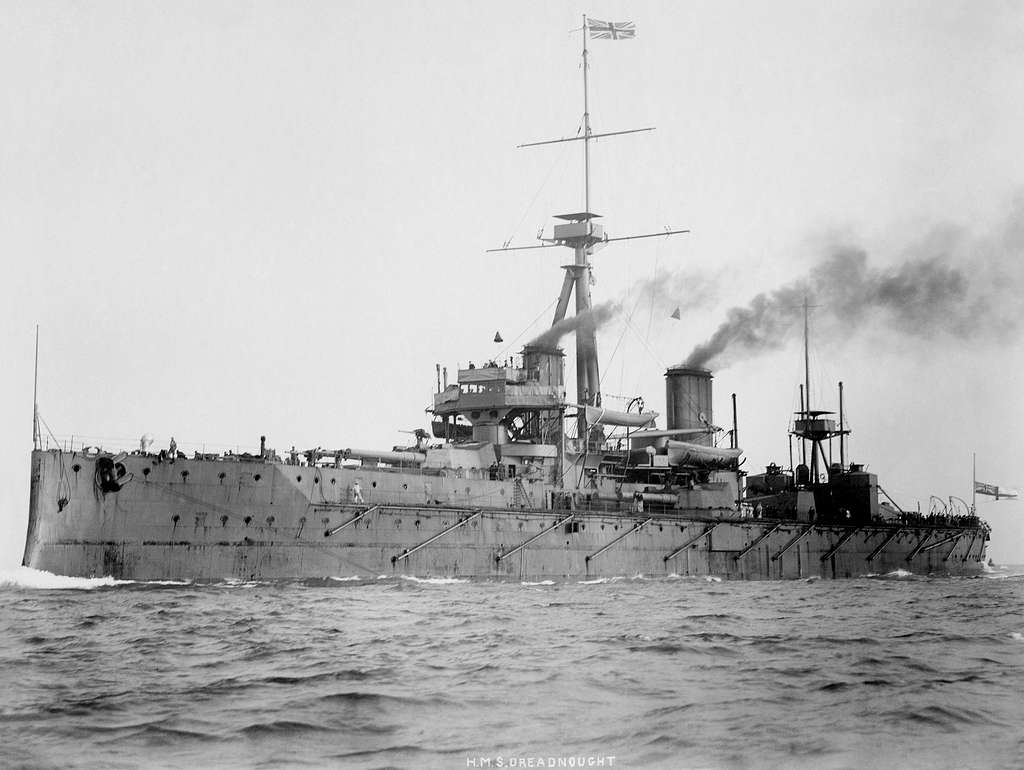
One of the most common popular conceptions of naval history is that HMS Dreadnought was a true revolution in battleship design and military affairs more broadly. As the story goes, the ship’s exclusive focus on big guns instantly made all previous ships obsolete. Sometimes the ship’s use of steam turbines is credited as part of this so-called revolution.
This article will examine various traits of Dreadnought and compare it to contemporary designs to demonstrate that Jackie Fisher’s marvel was nothing more than the British take on existing design trends and there is simply no such thing as the dreadnought Revolution in Military Affairs (RMA).
WHAT IS A BATTLESHIP?
The name battleship can conjure up all sorts of images. The mission of the battleship changed over time, notably during WW2. Generally speaking, the conceptual purpose of the battleship was the same from the age of sail until early in WW2. The steel armored, steam propelled battleship of 1908 had the same mission as wooden hulled, sail propelled examples from the age of sail: To control the seas by destroying the vessels of the enemy fleet. It can be made more complex than this, but for our purposes, it is comprehensive enough. All improvements from hull plating, to steam propulsion, to turreted guns had been made in an effort to improve the ship’s abilities to accomplish the mission.
WHAT MADE THE DREADNOUGHT SPECIAL?
Dreadnought can only be viewed as special if it was different. In this, the story holds up. The ship was clearly not like the other battleships in the Royal Navy and definitely had some characteristics that set her apart from battleships in other navies. The last battleships built for the Royal Navy before Dreadnought was the King Edward VII class, of which HMS Africa was the latest commissioned, having been in the fleet for less than four weeks before Dreadnought was commissioned. This being the case, I think it is fair to compare the two with Africa serving as the last best gasp of the pre-dreadnought era.
| HMS Africa | HMS Dreadnought | |
| Displacement | 15630 tons | 18110 tons |
| Length | 453 ft 9in | 527 ft |
| Beam | 78 ft | 82 ft |
| Engine Type | Reciprocating | Turbine |
| Engine HP | 18000 hp | 23000 hp |
| Max Speed | 18.5 kn | 21 kn |
| Range | 6700 nmi | 6620 nmi |
| 12-inch guns | 4 | 10 |
| 9.2-inch guns | 4 | 0 |
| 6-inch guns | 10 | 0 |
| 3-inch guns | 14 | 27 |
| 1.9 inch guns | 14 | 0 |
Looking across the stats, we can see the Dreadnought was longer and heavier. Much has been made of her being mounted with the turbines instead of reciprocating engines. However, a close examination of naval architecture reveals that horsepower is only part of the equation for speed. Hull form, length and beam all play a large role as well. The turbines were more efficient and allowed for more horsepower for a given size. They were not necessary to take a ship of that size to similar speeds, as proven by other navies of the period. Notably in this group was the American Delaware-class, which managed 21 knots on reciprocating steam engines
The armament is where the ship stands so clearly apart from her predecessors. The 12-inch gun was maximized, carrying ten, though still in the inefficient turret layouts that plagued many ships of the era. Dreadnought had no super firing arrangement and consequently could never bring more than 8 of the big guns to bear on a target, somewhat diminishing its advantage. Still, the armament was the critical point. There were many problems with carrying five or more calibers of guns, not least of which was inefficient logistics and terrible fire control.
What do all these differences add up to? Fundamentally they represent two different schools of thought on how battleship engagements were to happen. The dominant theory before Dreadnought was that ships would spot each other at relatively long range and attempt to cause damage with the inaccurate big guns as the two maneuvered closer together, eventually bringing the other batteries into range. These intermediate calibers guns were not just more accurate; they were also faster to operate.[i] The smallest batteries were reserved for defense against torpedo boats and other small threats.
The new school of thought being developed was centered on long-range gunfire capabilities. When combined with the pursuit of higher speeds, it would allow British battleships to dictate the pace of the battle. They could keep the range, minimizing exposure to the enemy’s intermediate calibers, while outgunning them in the big gun calibers. This doctrine would lead the British development of the battlecruiser. Not every navy would focus on speed as an essential element of the new battleship theory, but nearly every navy could see that massed long range heavy caliber gunfire was the future.
It is important to note that even the Royal Navy was not entirely sure of the success of the design, as evinced by the fact that they continued construction on three older designs and commissioned them after Dreadnought. There were second guesses at every major development in military affairs in history and the first decade of the 1900’s was no different.
WAS DREADNOUGHT FIRST?
The first and most famous part of the Dreadnought revolution to come under our scrutiny is that of time. The basic idea is that Dreadnought was first, and not only first in service, but first in construction and design. It can be difficult to prove exactly when designs were accepted and finalized, as they sometimes changed even after construction had begun.
However, if we look at construction and affirmative design conclusion, we can see that there are only two possible contenders for the title of first. HMS Dreadnought and the IJN Satsuma. Dreadnought was laid down in October of 1905 and saw little meaningful design changes while under construction. The Imperial Japanese Navy laid down Satsuma in May of 1905. Satsuma saw significant changes in her design during construction, most notably in her armament. She was originally planned to mount twelve 12-inch guns, an armament that would’ve far outclasses anything else on the seas. However, there were problems acquiring so many guns of this caliber in the time frame to keep the ship on schedule. Accordingly, eight of the planned twelve were downgraded to 10-inch guns. Another factor in her construction was that this was the first battleship ordered from Japan’s domestic shipyards, and she was by far the largest ship ever constructed by that nation. All of this amounted to a very late arrival for the Satsuma. She was not commissioned until March of 1910.
Tardiness in commissioning aside, Satsuma was not as fast as Dreadnought and used reciprocating steam engines instead of turbines. However, it is reasonable that if Satsuma had been finished in a reasonable timeframe, she could have been commissioned before the Royal Navy got their hands on Dreadnought. This would’ve made her the first all big-gun ship, and indeed, she was recognized even in her incomplete form as being a “semi-dreadnought.” The accompanying 10-inch guns were still lethal enough that they were considered to be in the same class as the larger 12-inch guns, if less capable.
Just between these two, it is fair to say that Dreadnought was not the first of the all-big gun designs. Even if we were to give the Royal Navy credit for designing the first one, the idea was obvious enough that most of the world’s major navies were working on designs, even if they had not moved to construction at the time that the Royal Navy did. Other examples are the German SMS Nassau, that while slower than Dreadnought, mounted four more 12-inch guns; and the American USS South Carolina, which was also slower than any of the others, mounted her guns in a much more flexible super-firing centerline layout that would prove to be the future of main armament arrangements for the next three decades.
WHAT IS A REVOLUTION IN MILITARY AFFAIRS ANYWAYS?
All of this brings us to our next point: That Dreadnought was not a Revolution in Military Affairs, either by itself or as part of a larger movement. This raises the question of what exactly is an RMA? What conditions can we look for to evaluate the validity of such a claim?
The entire premise is often in doubt, and I personally hold no loyalty to the idea. For the sake of this piece, let’s assume that they exist as phenomena that we can observe and study. We want to evaluate if HMS Dreadnought singly, and the dreadnought design principles broadly, constitute an RMA. To do so, we look at two factors:
- A new technology or system of thinking. There must be an innovation either in the philosophy or the hardware of war.
- Adaptation of the new technology or philosophy. This adaptation must either:
- Render a core competency of military operations and organization irrelevant. By the act of rendering one competency obsolete, it need not replace that which was thrown out.
- Adaptation can create a new core competency in and of itself that did not exist prior to the RMA.
Importantly either of the sub-factors can occur individually in conjunction with the first, or they may both occur with the first. However, one of them must happen in order to have an RMA at all.
THE IMPACT OF THE DREADNOUGHT
We have already seen how Dreadnought was different from her predecessors, and how the ship was similar to contemporary designs. What we haven’t discussed is the impact the Dreadnought had on Military Affairs. We must look for guidance in our 2 part test.
The first part of our test is innovation in either the technology or philosophy of war. What part of Dreadnought brought something new to the table. In the hardware of naval war, there was nothing that truly new with the Royal Navy’s newest. Destroyers had already been fitted out turbines for some time before Dreadnought was commissioned. Her 12-inch guns were not innovative in themselves, being the same guns mounted on her predecessors. There was nothing particularly new with her fire control or her armor scheme. The best that can be said for the technology of HMS Dreadnought is that she combined certain tangible features, like the turbines and the battleship mission, in ways that had not been done before. However, this did not create anything new in and of itself. Even if it could be construed that way, there are other obstacles to be overcome, as we will demonstrate later.
If not in the hardware department, was Dreadnought at least an innovation in the philosophy of war? The evidence for this case is thin at best. Supporters of the ship, then and now, will say that her all big gun arrangement changed the way battleships would fight. This is by virtue of captains who supposedly choose not to close with each other to bring the intermediate caliber guns into the fight, instead choosing to stay at range, using the large guns to pummel the opposition. Here, the supporters are probably correct. However, a change in tactics alone does not make a revolution in philosophy. Battleships continued to maintain the same role they had done since the early days of the Age of Sail. They were the center of the fleet, designed around the explicit purpose of destroying the enemy’s fighting ships and enabling smaller ships to take advantage of the now powerless enemy’s coast and trade-that is to enable Sea Control. Functionally, this mission had been the goal of some ship design since at the least the First Punic War saw the first clashes of large battle fleets. Dreadnought did not change this. Arguably this philosophy of the battleship as the centerpiece of a fleet that would find and engage the enemy’s fleet did not die until the end of the Second World War. Some might say it died earlier than that, but up until the last days of the war, the IJN and US Fleets were still operating at least partially under this assumption. We can see the last breaths of the ancient concepts at Surigao Strait and the fighting off Samar. The only reason we didn’t see more battle fleet action in 1945 is because one side had exhausted all of its resources. After the larger Battle of Leyte Gulf, there simply wasn’t a credible Imperial Japanese surface Navy for the USN to attempt to close with and destroy. At any rate, battle tactics come and go with the years, according to the whims of commanders and tacticians at war colleges. The mission set is the actual tangible representation of the philosophy at work. Dreadnought clearly failed to bring any meaningful innovations to this level.
However, even if one thought they could find some level of innovation in the philosophy or the hardware of war attributable to HMS Dreadnought, we must also look to our second element: the creation or destruction of a core competency in military affairs. At the time of Dreadnought’s commissioning, there were several things we might term core competencies in the naval world. Gunnery is one. Logistical planning for steam driven ship operations is another. Formation fighting and damage control are among the others. We do not need to list every core competency of early 20th Century navies to prove that Dreadnought did not destroy any of them or create a new one. We need only to look to the basic abilities of the ship and extrapolate what the differences between the ship and its predecessors meant for the operation of the battleship in the real world.
The armament arrangement was the single most drastic change that separated Dreadnought from her predecessors. But what did this mean in practice? Not much. As we have already mentioned, the 12-inch guns were not substantially different or modified from those used on earlier ships. This means that although there were more of them, they had similar armor penetration capabilities, range, explosive filler and dispersion. There just was nothing of note that made the guns themselves different or better, much less so drastically different as to create a new competency. If pressed, one might find that the earliest turret guns created a new competency in naval gunnery and maneuver that did not exist in the age of sail’s broadside focused battlefleets. But Dreadnought was long past this point, and sailors and officers were able to operate each gun as they had on older ships. Just as we can be sure that nothing spectacular existing in the armaments to create a new competency, we can see that no competency was destroyed. Intermediate caliber gunnery was not destroyed, but it was transferred to smaller ships, notably the developing concept of the heavy cruiser which in British service would mount 7.5-inch and 8-inch guns throughout their life.
This review leaves us with no reason to think that Dreadnought either created or destroyed any core competency in naval affairs. Without these we cannot find that Dreadnought’s commissioning heralded the arrival of a revolution in military affairs, or kicked one off. Even the ships famed impact on starting a new naval arms race is questionable. Many ships with similar design principles were under construction and most of the world’s most powerful navies had plans for their own version of Dreadnought.
We cannot hope to understand the nature of ongoing developments in military affairs if we do not understand history. Too many people are still praising the all-big gun battleship as the sign of a new dawn in naval affairs and how it revolutionized naval warfare. As we have seen in this brief overview, that couldn’t be further from the truth. This misunderstanding of developmental processes can be dangerous. What about the concept of the revolution in military affairs? It says something about the proponents of this concept that they often cite HMS Dreadnought as a classic example retroactively proving out the reality of the RMA. Exactly what that is, I leave to the reader to analyze. Words like innovation and revolution have become de rigueur in many defense circles, yet many times there is no historical understanding of how weapons and systems have evolved over time, often taking decades of slow and steady incremental work, not flash in the pan genius ideas that change everything overnight.
Hundley, Richard, Past Revolutions, Future Transformations: What Can the History of Revolutions in Military Affairs Tell Us About Transforming the U.S. Military? Santa Monica, CA: RAND Corporation,
Gibbons, Tony. 1983. The Complete Encylopedia of Battleships and Battlecruisers. London: Salamander Books LTD.
Conway Maritime Press. 1985. Conway’s All The World’s FIghting Ships 1906-1921.Annapolis: Naval Insittue Press.
Krepinevich, Andrew F., Jr. The Military-Technical Revolution: A Preliminary Assessment. Washington, D.C. 2002. Center for Strategic and Budgetary Assessments
Fitzsimonds, James R.; Van Tol, Jan M., Revolutions in Military Affairs. Washington, D.C. 1994. Joint Forces Quarterly
Murray, Williamson. Thinking About Revolutions in Military Affairs. Washington, D.C. 1997. Joint Forces Quarterly

 Inconvenient War studies
Leave a comment