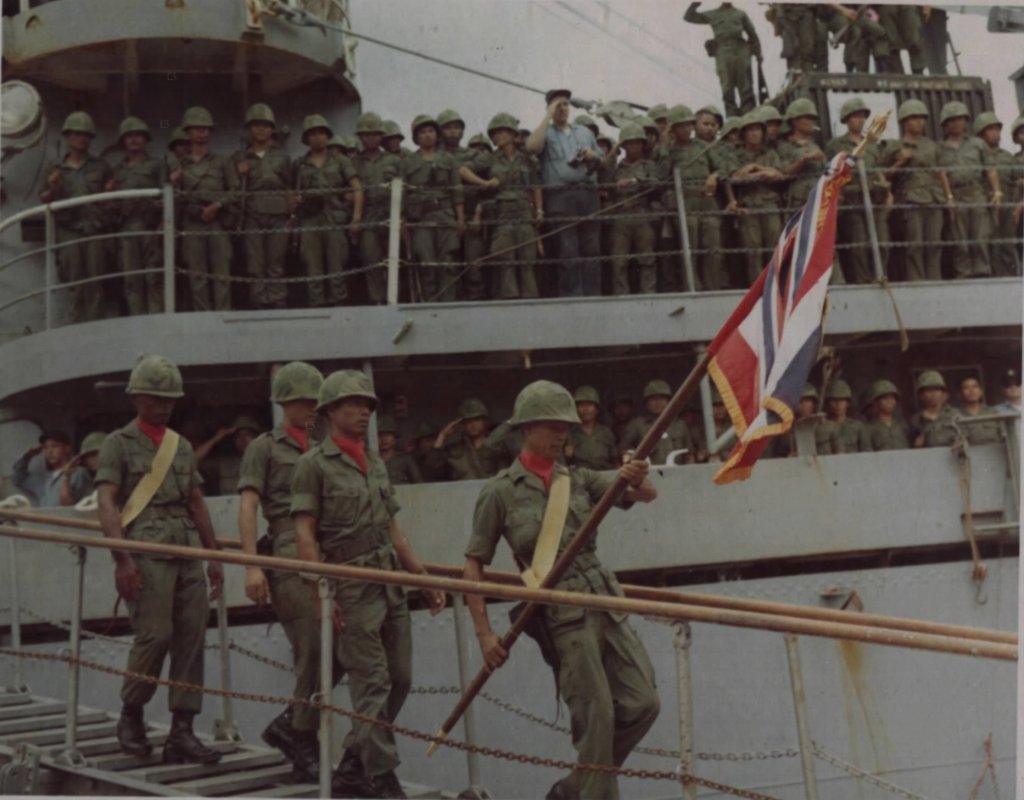
The Vietnam War is essentially viewed as an American-Vietnamese affair. This couldn’t be further from the truth. Support and supplies came from all over the globe for both the South and North Vietnamese efforts. There were dozens of nations all over the globe aiding one side or the other. These nations had ideological leanings across the spectrum, each with their own interpretation of loyalty to Moscow or Washington. Some saw it as mission to secure regional stability, others a means to improve their prestige with the larger powers, and still others who simply saw compatriots in need of assistance. This article will be the first in a series discussing the nature of the two major partnerships of the Vietnam War, and this first part will focus on highlighting the military aid provided by American led axis in South Vietnam.
The Vietnam War was for all intents and purposes, a coalition war on both sides. What is a coalition war? The term has been thrown around in American media for several decades, perhaps most famously for the 1991 Liberation of Kuwait. For the purposes of this piece, we can work from the assumption that a coalition is a temporary, informal, and limited partnership between nations for the purposes of fighting a war. A coalition member does not need to send its fighting troops to the war, but can contribute resources, material, or even just money. What matters is that the contributions are made in an intentional and concrete manner. Merely offering conditional support does not make one a coalition member.
The Vietnam War could be considered to span a period of time that far outstretches American military participation, but for the purposes of this article, lets contain our discussion from the period 1962-1973. This was the period of the most active global involvement. It is also the time that the American Military Assistance Command-Vietnam (MAC-V ) was in force. MAC-V represented the pinnacle of “western” involvement, as organized primarily by Washington, D.C. Moscow and Beijing served as sort of dual arbiters for Communist aid to North Vietnam, but Hanoi was much more independent in its foreign relations than Saigon was during this period.
The American Government worked hard to create partnerships that would outlive the war, but these ventures failed almost entirely. Probably most prominent of these attempts was SEATO, or the Southeast Asian Treaty Organization. This was conjured up as a sort of Southeast Asian equivalent to NATO. However, unlike that organization, SEATO had no real military structures. It was also populated by few of the actual Southeast Asian countries it purported to protect. Thailand and the Philippines were the only ones to join it. Australia and New Zealand joined, but they were considered to be regional players who had an interest but not territory in Southeast Asia itself. Whole books can and have been written on SEATO.[i] Suffice it say that the SEATO was designed to protect SEA from the spread of communism but had little buy in from the states of the region. South Vietnam was specifically excluded from being able to join military alliances by the Geneva Convention in 1954. The United States worked hard to legitimize SEATO and used it as a public reason that South Vietnam could be aided at all. Australia and New Zealand also followed suit with this reasoning. After 1960, American involvement in South Vietnam ramped up. No formal treaties were signed, even as the war escalated and the Military Assistance Advisory Group (MAAG) was put into place, then followed and eventually supplanted by MAC-V. In 1966, the US State Department issued a legal memo detailing the basis of American involvement in the war.[ii] The highlights of the memo include that while there was no treaty between the two nations, the South Vietnamese had asked for US help, and various US Presidents had promised aid. These promises began to take the form of a coalition, unnamed, to assist South Vietnam fight for its independence and to crush the internal rebellion led by the so called Viet-Cong. [iii] There were literally dozens of nations that supported the US led mission at one point or another, but again, the focus here is on the military assistance by the coalition members organized around aiding South Vietnam. Let’s address the military allies’ contributions to the mission in turn.
The Australian Government was approached by Dean Rusk in 1962 and told that the American military essentially had little experience in fighting in the jungle. The Australians had just finished helping the British in similar terrain during the Malayan Emergency, and it was felt that they could assist in South Vietnam. [iv]At no time was the ANZUS treaty invoked, and all of the talks between the US and Australia were conducted informally. Australia started her commitment in 1962 by sending advisors under the guise of the Australian Army Training Team Vietnam (AATTV). In 1965, apparently again at the behest of the Americans, Australia would upgrade her commitment in country by sending an Infantry Battalion. This was a somewhat delicate move that required some political maneuvering. The South Vietnamese government was apparently anxious about yet more foreign troops being a propaganda victory for the North Vietnamese. Still, eventually, that South Vietnamese were pressured by all sides, and made a formal request for Australian armed involvement. But a request was all that it could be, as there were still no treaties between the Australians and the South Vietnamese, and the US had no invoked ANZUS. Still the Aussies delivered. At the peak of Australian involvement in 1969, they had almost 10,000 troops deployed to the country. Eventually, nearly 60,000 Aussies served in the country.
The New Zealanders were operating under essentially identical circumstances. As the Americans escalated their support of the newly independent South Vietnamese, they attempted to pressure the New Zealanders. The Kiwi’s remained wary of the war, and when the US State Department asked for a compliment of advisors to serve alongside the AATV, Prime Minister Holyoake refused.[v] Instead, a team of civilian surgeons was put together and dispatched. Eventually, in 1964 Holyoake caved and sent a team of advisors and army engineers to South Vietnam. The engineers were to help solely with civilian reconstruction efforts. The next year, as the Australian and American efforts were ramping up, so too did the pressure on New Zealand. Before the middle of the year, the heretofore steadfast Holyoake government caved and agreed to send an artillery battery to the war. The peak came in 1968 when 548 New Zealanders were deployed to the South Vietnam.
Throughout the war in Vietnam, the New Zealanders did not volunteer to aid the South Vietnamese. Instead, we see the US pressuring the Kiwi Government, in order to continue to build an impression of a coalition fighting the war. That such an impression was important to the American Government is instructive. The Americans had multiple reasons for wanting a coalition. The first was for domestic political support. As well, American military planners worried about over commitment to the theater that might result in an inability to defend her interests elsewhere. Aid from its regional allies would help on both accounts. However, this is fundamentally a part of how coalitions operate. From the coalitions against Napoleon to the 1991 Coalition against Saddam, time and a time again we see members having to be pressured to join. The quid pro quo is a timeless tool of powers seeking to build international support for their war goals.
The Philippines occupied a different tier of independence from American pressure. They had freely signed up for SEATO and believed wholeheartedly that it was the path forward for collective security in the face of certain Communist expansion. The Philippine Government had signed a formal “Treaty of Friendship” with South Vietnam in 1959, but this contained no clauses on defense. [vi] The South Vietnamese Government felt strong enough to reach out and ask the Filipino Government directly for aid, a rare case of independent dealing by the masters of Saigon. They were made with the understanding that the US agreed with them. The first of these calls for aid came in 1965. The newly minted leader of the Junta, Nguyễn Khánh, wrote a letter to the President of the Philippines asking for aid. The response was to organize military doctors, engineers, and advisors into what would become the Philippine Civic Action Group (PHILCAG). [vii] This contingent proved to be very small, numbering less than 100. There was internal political opposition in the Philippines to sending more, as well terse negotiations with the US over who would pay for the troops.
Eventually these obstacles were overcome in the summer of 1966. Later that year, the Manila Conference was held. Seven nations were in attendance, Australia, New Zealand, Philippines, South Korea, South Vietnam, Thailand, and the United States. The purpose was primarily to demonstrate international support for the coalition and prepare. To that end, a series of proclamations were issued, including a peace proposal. This was of course rejected by the North Vietnamese, but it set the groundwork for the expanding role of non-American foreign troops. Later that year, further troops would depart for South Vietnam, reaching the highest levels of around 2,000. These numbers were maintained until after the Tet Offensive.
The South Koreans started their assistance in 1964, and its presence in South Vietnam would grow to become second only to the Americans. From the start, their situation was unique. The Republic of Korea (ROK) was still not self-sustaining in the ‘60s, and recovery from the Democratic People’s Republic of Korea’s (DPRK) invasion of 1950 was not assured. The United States subsidized almost the entire military and political life of the country, but that was changing. DPRK aggression had changed forms, switching to more unconventional methods after their defeat at the hands of the UN forces. However, they were still eager to eventually try unification by force. This environment coupled with an increasingly disinterested Washington, D.C. left ROK leaders struggling to find ways to remain relevant to US security needs.
Publicly, President Park’s justifications for sending large detachments of his soldiers to South Vietnam centered on moral responsibilities to the free world. During his new years speech to the National Assembly, he said:
” Where would we be today had our Free World allies not come to our assistance fifteen years ago? Our troops are not in Vietnam purely in the interest of our own safety. More significantly, we are making a moral repayment of our historical debt to the Free World.”[viii]
Meaningful levels of intervention by the ROK did not start until 1964, when a team of approximately 130 doctors, nurses, and surgeons was sent to South Vietnam. The intention was that they would travel from village to village treating victims of military action, as well a team of 10 karate instructors were sent, presumably to help train the ARVN in hand-to-hand combat. This relatively paltry force was soon boosted in March 1964 when the “Dove Corps” was deployed, consisting of around 2,400 engineers and an accompanying security detachment. In 1965 the ROK’s deployments reached a new height when a full army division and marine regiment were deployed to the country. This was furthered in 1966 when two more divisions were sent to South Vietnam and in ’67 when a marine brigade was added. [ix]The peak contribution numbered a little more than 50,000. Eventually, over 300,000 South Koreans would rotate to the war. For these efforts, the ROK received millions in continued direct support from the US Government and much more in investment that was greenlighted from the same.
Perhaps the most overlooked of America’s allies in the struggle of the Vietnam War also deployed the second most troops of those friends. Thailand is rarely brought up when discussing the war, and when it is, the lending of land for airbases for American bombers receives primacy in the ink spilling. Laotian jungles often get more attention for hosting Ho Chi Minh’s infamous trail, and Cambodia for being a hapless victim to Kissinger and Nixon’s evil plans. Yet, the Thais would suffer 1700 casualties pacifying Bein Hoa over the course of about three years. At first the Thai Government sent pilots in 1964 to fly American cargo planes. In 1967 they would send their first ground troops, a regiment, followed by a division the following year. Manning and equipping these troops, perhaps more than any others, was presaged by intense discussion between the two governments. [x] The Thais relied entirely on US weapons and were not fully equipped as they were being prepped to deploy to South Vietnam. At the same time, the US was facing its own production shortages of various equipment and was struggling to meet the needs of its allies, its own modernization programs, and replace battle losses. Eventually these kinks were worked out, but that they existed at all is demonstrative of the state of US warmaking abilities in the middle 60’s. It lends some credence to an idea that the US needed the coalition for more than its prestige.
Throughout the war, agreements for expansion of US airbases, further involvement of Thai military forces in Vietnam and other matters were never solidified with treaties or written agreements. Instead, the informal quid pro quo was used here as elsewhere. Various Presidential administrations with varying levels of deniability encouraged and expanded American aid to Thailand in exchange for the increased support of the country. Thai support was initially supposed to be covert, but as the American presence expanded it became nearly impossible to hide the facts. Still, covert missions persisted, with Thai special forces running ops deep into Laos, sometimes alongside Americans, sometimes with aid and assistance but not direct involvement. [xi] These missions were part of a crucial segment of the war that was somewhat parallel to the conventional forces’ missions. The overall goal was the same, pacify South Vietnam and build space for the local government to thrive, but the means were far different.
This covert side of the war was also a place of significant assistance by the last major member of the coalition formed by the United States to fight the war. The Republic of China’s (ROC) role in covert operations is not covered in the Center of Military History’s sanctioned history. [xii] However, the US used the island nation throughout the war for airbases, and the Chinese sent operatives to South Vietnam, and probably to North Vietnam for a variety of purposes, few of which are clear even today. Officially, in 1964 fourteen political warfare advisors were dispatched to serve in the corps commands of the ARVN, among other commands. There were also doctors and agricultural experts that were sent to aid in various provincial centers throughout the latter half of the 1960’s. In 1966 Westmoreland asked for a ROC marine brigade, but political concerns about upsetting the Peoples Republic of China squashed this before it gained much traction. However, assistance, covert and overt, continued even though ROC troops never deployed to the mainland.
All of this to say demonstrate that the scope of military and intelligence related assistance by these allies was of such a proportion as to make them coalition members with the United States and South Vietnam in their war for the latter’s independence.
What can we learn from this? First, coalition warfare can happen even if it goes unacknowledged and unnamed. This is important because once we realize that war coalitions sometimes hide in the background of our histories and recollections of the war, we can begin to understand that few, if any, American military adventures are unsupported. In the current environment of isolationism, we see narratives being crafted that paint America standing alone fighting and losing in places like Vietnam, Iraq, and Afghanistan. These narratives fly in the face of facts, but they persist in the corrupted information environment we live in regardless of their truthfulness.
Secondly, we were able to see the briefest glimpses into the political considerations on all sides that informed the military assistance. Too often we see our military histories divorced from political messiness that does not just inform but shapes the conflict. The US asked for assistance, not only for battlefield reasons, but to shape the world’s understanding of the mission in South Vietnam. The political masters of the war in D.C. fought to not just have the war appear international, but to actually make it international! There were important reasons for this, which must be gone in depth in another piece, but consider why this was important. The answers might surprise you. This piece is a mere introduction, an overview of the highest order, and little more. But hopefully it helps to spark the lay reader to investigate further and pursue knowledge beyond this space.
[i] The SEATO Charter: https://treaties.un.org/doc/publication/unts/volume%20209/volume-209-i-2819-english.pdf
[ii] https://calhum.org/files/uploads/program_related/TD_US_Participation_in_VN.pdf
[iii] The name Viet-Cong is a misnomer applied to the National Liberation Front of South Vietnam. It is a short form of the phrase for Vietnamese Communist.
[iv] https://www.nma.gov.au/defining-moments/resources/australian-troops-committed-to-vietnam#:~:text=Australian%20Army%20Training%20Team%20Vietnam%20In%201962,had%20signed%20the%20ANZUS%20treaty%20in%201951.
[v] Rabel, R. (2005). New Zealand and the Vietnam War: Politics and Diplomacy. Auckland: Auckland University Press.
[vi] In keeping with the Geneva Conventions of 1954. https://repository.mainlib.upd.edu.ph/omekas/files/original/fd82231d3e40ae18c125ec316ad450a46868de6d.pdf
[vii] https://utoronto.scholaris.ca/server/api/core/bitstreams/ebcb2243-f083-48e8-a09f-214b5467360c/content
[viii] https://www.jstor.org/stable/20670745?read-now=1&seq=1#page_scan_tab_contents
[ix] https://api.drum.lib.umd.edu/server/api/core/bitstreams/a9a428d5-0b11-4e40-b044-cd8f8ffeead7/content
[x] https://webdoc.sub.gwdg.de/ebook/p/2005/CMH_2/www.army.mil/cmh-pg/books/vietnam/allied/ch02.htm
[xi] https://journals.lib.unb.ca/index.php/jcs/article/view/292/465
[xii] https://webdoc.sub.gwdg.de/ebook/p/2005/CMH_2/www.army.mil/cmh-pg/books/vietnam/allied/ch05.htm


 Inconvenient War studies
Leave a reply to jrmoockjr Cancel reply