War has been a subject of fictional and documentary films since the earliest days of the technology. People watch them for many reasons, but perhaps one of the most common takeaways from a war movie is one question: How real was this?
I think that question is misguided at best, as the art of movie making allows- indeed, requires- abstraction of any number of basic functions of reality as a means of storytelling. Storytelling is first and foremost about communication and the teller must choose what to communicate and how to do it. The visual nature of films requires some level of abstraction in the communication, as all mediums do.
So, the question that should be asked is not “How real was this movie?” but instead “How accurately did this movie convey a story of war?” It might feel like splitting hairs, but I think it’s important to remember the distinction. It is my firm belief that war is too large of an endeavor to be captured in its totality by any one story, but any valuable war movie should give an insight into at least one aspect of war.
Too often, lists of the best war movies are put together with no consideration for how accurately the movie conveys the FEELING of war. These lists are made by usually made not by people with an intimate knowledge of war, but instead film critics, people who understand how films are put together not how wars are experienced. This is a shortcoming that reflects a broader misunderstanding of war by our society and the distance with which it is viewed.
To correct this shortcoming, I’ve put together a brief list of war movies that I think accurately capture some aspect of war. There are some picks here that might be considered… unconventional, but I stand by them. Each movie stands in for an aspect of experience of war, though I don’t claim this to be the conclusive list of every possible angle of that experience. I am no film critic, but here goes nothing:
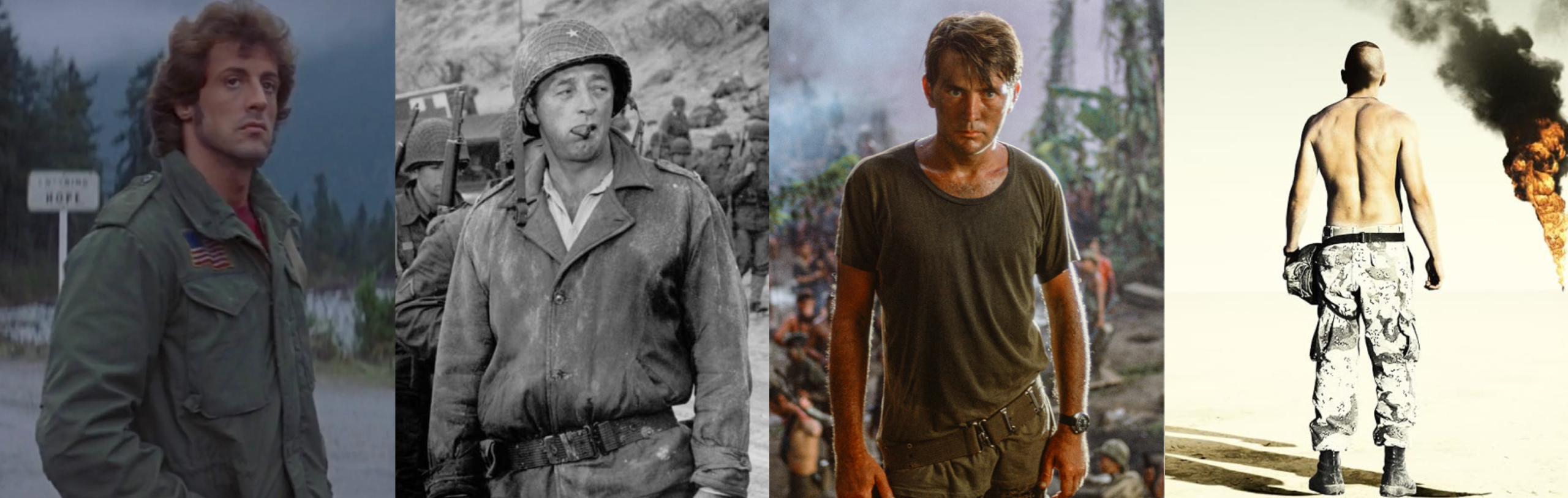
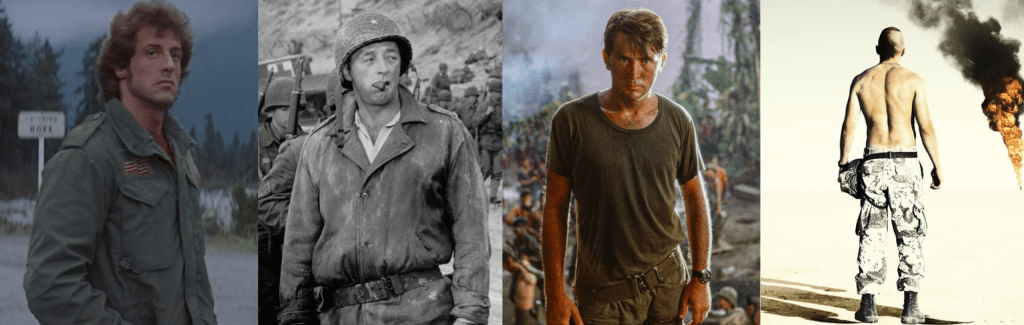
Rambo First Blood Part One— War against Oneself
This movie is probably the most controversial pick on the list, but its also the one I feel most strongly about its placement on this list. Rambo as a movie series is many things, but the First Blood Part One is a special insight into war. It’s not the action or even the obvious PTSD that John Rambo suffers from. What makes this movie special is the way it confronts that the entire arc of the story is about Rambo fighting himself. It’s about the war within. He is suffering from obvious trauma from being tortured and his combat experiences, but what is really holding him back is that he can’t let go. He can’t or won’t square who he is with who he thought he was.
John Rambo struggles with his guilt over the war, he struggles with his fear of being normal and perhaps most of all, he struggles with the idea that he is accountable. As he descends further into the forest, he slowly loses the battle for control of his mind. Madness descends on him as he sets his traps and struggles with refighting Vietnam in his own mind. We are to understand this as a side effect of his fighting in a war without cause. However, wars of any purpose or justification drag the participants into a state of internal dissension. The overwhelming mass of people are taught that we mustn’t give in to our base instincts, and that we need to reason through our experiences and emotions, coming out on top a controlled rational person. War tears that away from you. It throws you into a cesspool of depravity and moral darkness. There is no reason in war and to dry to discern one is a useless endeavor. Random chance reigns around you as bullets miss one person, strike another uselessly, and kill a third instantly. Experiencing this world of madness drives internal divisions as your rational mind seeks to understand what cant be understood.
Many veterans and civilians go through something like this when wars end, and more than occasionally, while the war is still happening around them. It is natural to challenge your perceptions of yourself after any major event, and war is close to the top of any major event in one’s life. Where it transforms from challenging yourself to a war within is line that can’t be easily discerned. Too often, we dismiss the internal psychological conflicts that arise from war.
Coming home from war is ultimately a form of psychosis where you have to let go and accept that one side of you is now worse than useless, it is actively hostile to your daily life. We see Rambo struggle to contain himself as he begs to be left alone, and we see how he loses the battle at the movies’ climax and he resorts to his baser war self, surrendering reason. Veterans and active soldiers are rarely, if ever at risk of a Rambo style rampage of course, but we must understand that internal strife brings real consequences to our lives. Rambo First Blood brings that to life for those that care to look deeper than its action.
Apocalypse Now — War as Confusion
What Apocalypse Now is actually about has been endlessly debated by everyone from professional film critics to video essayists on YouTube. I wont claim to reveal the meaning of the film, but I do think that among its myriad interpretations there is room for one more.
Apocalypse Now is a perfect encapsulation of war as confusion. No one in the film understands what they are doing, why they are doing it, or how to finish it. Confusion reigns from General Corman to Colonel Kurtz himself and everyone between. Thus, war. This is not just the Global War on Terror-colored glasses on my own face. We see confusion in every war. Read war memoirs and you will see confusion in purpose at every level of war in every era of life. People lose perspective in the vast currents of war as they swirl, around you, through you, over you. Sometimes you go in with a clarity of purpose and morality, but you never retain it in the mud and blood.
We must accept that confusion is more than a fog it is the essence of war, and Apocalypse Now shows us this in shockingly raw detail as Williard proceeds up the river, immersing himself further and further into the nature of war. Confusion reigns internally as he narrates his journey taking us to the “heart of darkness,” Kurtz in his temple. He believes that once he confronts Kurtz he will understand but once there Williard realizes that he is more confused than ever before. The same is true when one experiences war. We often convince ourselves that war is a filter for certain feelings and that once we go through it, that we will arrive on the other side with clarity and purpose. Instead, we find nothing, but what we brought with us.
War is not a filter, it is not a fulfilling purpose, it is not a prism that divides us into extraneous and essential components. It is instead a morass that no one escapes from. Wars, like the muddy river of Apocalypse Now, do not reveal secrets about people, and like the film’s jungle, they are untamable monstrosities that only consume more as you proceed further into them.
Jarhead — War as Disappointment
This is another controversial pick, I’m sure. Jarhead builds anticipation for Desert Storm both on screen and in the story of the Marines preparing to fight it. As the war progresses, we see how, at every turn, there is nothing but disappointment. There are no heroes. No dramatic clashes and damn sure no satisfaction.
War rarely has big pay-off moments. Even after a firefight where you defend your patrol base for hours as rockets and machine gun fire rakes your walls. When its over, you just look around and wonder if it is actually over. You assess the damage, check ammo levels and prep for a return to the grinding routine of daily life. Victory in films is often demonstrated by celebrations, joy and sometimes a moment of reflection for the cost. Jarhead avoids this trope for the most part and shows a war that doesn’t really end, but sort of just drifts further and further away. Wars and the battles within them end on whimpers, the fire just dies down, and you assume there is no more shooting to do.
Too often we expect dramatic moments and heroes rising to the occasion, but instead we get mind numbing monotony and soldiers begging for something to happen. You can do 9 months next to some river in some country on the other side of the world and never hear an enemy weapon, or you can spend 3 weeks on the other side of the river 2 miles away and never have a moment of peace as all hell reigns down on you. Either way, you will be disappointed. Jarhead captures this. It makes you feel the anxiety build as you expect something to happen, and then when the moment comes, your tension is wiped away, and nothing ever happens. The Marines of the film patrol through the endless desert searching for an enemy that isn’t there anymore. They struggle to comprehend the ugliness of the post-apocalyptic wasteland of the burning oil fields, but there is no relief.
Stepping on a plastic water bottle in a dark poppy field and hearing the crunch, your heart races, expecting the wires to make contact and the explosion to take your legs, and only your legs if you’re lucky. But the moments pound away in your ears, and you look around and nothing happens. So, you keep walking and leave the tension behind forever. Disappointing, really.
The Longest Day — The Complexity of War
Somewhere in our stories of war, the complexity of it all often gets left behind. The Longest Day helps to bring it back into the conversation. The camera takes a moment here and there to take in the vastness of the Allies’ preparations for D-Day, with hundreds of thousands of men in some shots, or at least implied through the presence of props.
The Longest Day does not hesitate to spend entire minutes of its running time on frantic staff officers on both sides of the invasion desperately trying to map out information in the background while more important men take phone calls and argue over deployments. In almost every scene, we are encouraged to see the background and the many moving parts that make the machinery of war run, smoothly or otherwise.
In fact, any endeavor of war is so large as to be nearly incomprehensible to the soldier and civilian alike. Our American Wars in Afghanistan and Iraq required tails of logistics that wrapped the globe. Staff officers and policy wonks in DC were fond discussing the size of this so-called tooth-to-tail ratio, but its magnitude was inevitable. Supporting soldiers with ammunition and food and security for all of it required a boggling array of parts working together and sometimes not. This picture of complexity, like The Longest Day does not even begin to touch on the manufacturing, the politics and the civilians who work silently to support the war, each in their own tiny way. The film takes a moment to show the dockworkers as they grind around the clock, but cannot find time to show the shipbuilders, the farmers, the truck drivers or the thousands of other roles required to bring the war to bear on the enemy.
The Longest Day, for all of its limitations, still dares to show the viewer the vastness of the machinery of war. It dares to remind the viewer that they haven’t thought of all the components, all of the intricacies that are in every way effort.
Wars defy accurate representation. Be that as it may, the films listed here help to illuminate an essential part of the experience of war. They are not flawless in their capture, but they do something to help us understand and contextualize the experience of war. The next part of this list will contain four more films representing four more aspects: Comedy, Meaninglessness, Redemption and the Uncounted Costs.


Leave a comment